Plan a Minecraft Circle Wall Design From Above
Plan a Minecraft circle wall design from above: choose its block span, follow blueprint rows, and identify the outline's material count.
On this page
There are two different ways to plan out a Minecraft circle wall design, depending on what you want the shape to represent. If you’re building an ornamental wall that has a circular footprint (like a wall around a garden or a round tower), you can treat the footprint of the circle as a regular polygon with its diameter being the full length across. You’ll be planning this horizontal footprint from above, rather than looking face-on at a circle in a vertical wall.
If, instead, you’re building a window that’s circular in shape, then it will appear as a circle when viewed face-on to the wall and is placed against the vertical side of your structure. In that case, you’ll be planning the circle as though it were placed on top of the floor. The circle will span as many rows of the wall as its diameter — 7 blocks high for a 7-block-wide window, leaving one row above and below if the wall is 9 blocks high.
The circle will be planned based on how far away from the center the corners of the circle are located. If the radius of the circle is one block away from the center, the distance between the centers of each of the blocks will vary slightly.
But there are some other considerations that must be made before choosing where exactly to place each block in the circle.
First, you need to decide on the size of the circle. For example, does the circle span 3 blocks, 5, or 7? That determines how much room you’ll need in your structure and how many blocks you’ll need for the circle itself. You also need to know whether the center of the circle is a single full block, like the middle block of a circle of odd-sized diameters, or whether the center will be different than it otherwise would be, like when placing a circle of even-sized diameters.
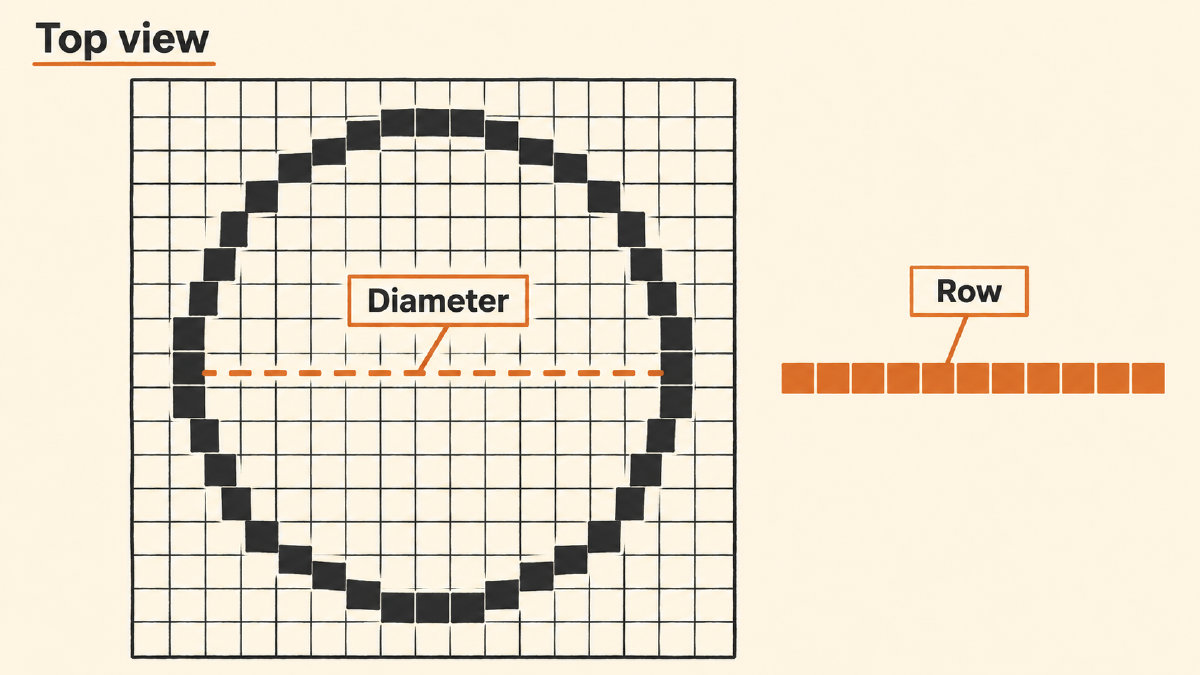
You can use an online generator to choose a specific blueprint, but there are several layouts that may be used, too. One way to determine which layout to choose is by using a printable circle chart with twelve common layouts and their corresponding footprints, so that you can select a layout and build accordingly.
How to Choose the Footprint
The circle footprint must span an exact number of blocks, including both ends of the span. For example, if the circle spans 3 blocks, then it must include the two end points and the one block in between. The same goes for any other odd number.
A circle with an even number of blocks is a bit more complicated. For example, if the circle spans four blocks, then the diameter is 4, but the circle’s center will be positioned differently. Instead of a single block being in the center of the circle, there will be a pair of blocks adjacent to each other. Similarly, a circle spanning six blocks will have its center in the gap between the two middle blocks along its diameter.
You can either use an online generator to help choose a layout and count the materials you’ll need for the design, or simply refer to the list below.
Circle Layouts
The following lists the layouts that you can generate online:
Size 2x2
Size 3x3
Size 4x4
Size 5x5
Size 6x6
Size 7x7
Size 8x8
Size 9x9
Size 10x10
Size 11x11
Size 12x12
Size 13x13
Size 14x14
Size 15x15
Size 16x16
You’ll probably choose one of these layouts for the circle’s footprint. Then you can use the rows of the layout as a reference to place the blocks that make up the circle’s outline. Each row represents a line of placement: the first row might represent the bottommost portion of the circle, the second the next line of placement, etc.
Material Requirements
Now imagine you’ve decided to use the 5×5 layout. There are a few different options to consider, but we’ll assume that the layout will remain as described, without making changes to the thickness of the circle’s footprints or adding in entrances, pillars, and repeated decorative sections. A thicker footprint, for example, will change the material requirements significantly.
Material requirements depend on the particular outline you choose, so count its blocks rather than relying on whether its diameter is odd or even. The 5×5 layout requires 12 blocks, while the 7×7 layout requires 16 blocks.
If you plan to modify the circle (adding a doorway, a pillar, or simply thickening the circle’s footprint), then you’ll have to do the math again.
What You Need To Know About Circle Layouts
The supplied material does not establish this page’s original publication or editing credits. All rights reserved.