Calculate Concentric Circles Area for a Minecraft Ring Floor
Calculate concentric circles area with π(R² − r²), then count a Minecraft ring floor on a shared-center grid with explicit boundary rules.
On this page
An annulus is the region between two concentric circles.
The area of an annulus is the area of the larger circle minus the smaller. This can be calculated by subtracting the square of the inner radius from the square of the outer radius and then multiplying by π.
When calculating how many blocks are needed to build an annular floor in Minecraft, we have to remember that this is not simply an estimate. There’s also a way to exactly count the number of blocks required.
In Minecraft, there are several ways you can lay down an annular (ring) floor. The simplest method uses concentric rings, where you use a full block height at each concentric ring. The most efficient, however, uses a single layer of blocks per concentric ring.
To do so, you’ll want to find a grid layout that will allow you to create the annulus, either as an exact count or just as a rough estimate. You’ll need to know the geometry of your floor plan and align it on your grid to ensure you’re counting exactly what you need to.
Let’s first talk about the annulus
The annulus is the geometric model we’ll use here. As a general rule, an annulus is the region between two concentric circles (sharing a common center point), which means both circles are defined by the same origin point but have different radii. In other words, one of them has a larger radius than the other.
For our purposes, we’ll define an annulus as a flat ring that represents a Minecraft floor, with the following characteristics:
It is one block thick. So, the annulus consists of a series of concentric rings — all connected and forming a continuous ring structure. It’s like a donut: the doughnut shape, but only one unit thick.
We’re going to ignore Minecraft’s 3D world and think about the annulus as a 2D plane. We won’t worry about height; instead, we’ll focus solely on the horizontal plane.
You can think of the annulus as having a “continuous” boundary, where its edges form the outermost ring of the annulus and the interior is empty (the hole). If we were to place a transparent glass block over the entire annulus, it would look like a ring.
Calculating the area
We’ll start by working out the formulae that calculate the area of an annulus. The area is equal to the area of the outer disk minus the area of the inner disk. That means A = π(R² − r²), where R is the radius of the larger circle, and r is the radius of the smaller circle.
Because we’ll work with diameters, let’s consider D to be the diameter of the larger circle, and d to be the diameter of the smaller circle. Then, R = D/2 and r = d/2. Thus, A = π(D² − d²)/4.
For example, suppose we have a continuous outer diameter of 20 units and a continuous inner diameter of 12 units. Then, D = 20, d = 12. R = D/2 = 10 and r = d/2 = 6. Then, A = π(10² − 6²) = π(100 − 36) = π×64 ≈ 201.1 square block units.
This is the estimated number of blocks you’ll need to construct the ring-shaped floor. Note that the full block span isn’t quite the same as a continuous boundary. For a filled-in pattern of blocks, we’ll need a specific grid-cell selection rule before we can establish the exact count; 201.1 is only an area-based estimate.
However, we can also say that the number of blocks will vary depending on whether we select certain grid cells, and the rules that we apply to decide which cells we include in the total.
A preliminary material estimate versus an exact floor count
The easiest way to estimate how many blocks you’ll need is to treat the annulus as a continuous shape. Because it’s continuous, we can compute the exact area and divide it by the volume of a block (which, in Minecraft, is 1 cubic unit) to get a rough estimate.
But the question is, does the area of the annulus translate into a block estimate? To answer this, I’ve outlined the process below.
First, you must choose a set of grid cells. Each grid cell represents a potential block you could place, though the placement of that block depends on a number of things. For now, let’s imagine that the floor is constructed using an explicit rule to determine whether any given grid cell belongs to the annulus. That rule could be anything.
If the rule states that a cell lies within the annulus, then that cell will be included in the total count of blocks needed. Otherwise, it will not.
In our earlier example, we had an annulus that was 20 units wide and 12 units wide inside. That gave us a total area of roughly 201.1 square block units. Dividing that by the size of a single block (which is a cube measuring 1×1×1 block units) gives us the approximate number of blocks we’ll need. But again, since we’re dealing with a continuous shape, it’s not possible to provide an exact count of blocks, unless you define a specific rule.
For our one-block-thick floor, we’ll count one block for each selected grid cell in the horizontal plane. The challenge arises when trying to figure out which of these cubes belong to the annulus.
There are a number of ways you can go about this. One option is to select the floor cells manually on a shared grid, following your chosen boundary rule. Alternatively, you could generate a script that calculates which blocks need to be placed in order to create an annulus. In either case, you have to consider which block positions fall within the annulus, according to whatever criteria you choose.
Shared-center alignment
One approach is to position each plan at the midpoint of its own grid, so that the center of each annulus is shared by all plans in the final composition. That allows you to avoid worrying about offsets, and ensures that each of your concentric rings is correctly aligned with the rest of the plan.
To ensure the correct placement, we can take advantage of the fact that both the inner and outer boundaries of the annulus will be defined by the width of each plan. That means that both plans will share a common midpoint. However, to prevent half-cell offsets, we’ll need to choose inner and outer plans with matching parity in each dimension: both odd or both even. Moving a plan by whole grid cells won’t align an odd-span midpoint with an even-span midpoint.
In particular, a full block span includes both ends of the span. If the span is odd, then it includes the middle block. If it’s even, then the center of the span is the midpoint between the two central blocks. If the plan is arranged as a centered square, then the midpoint of both the inner and outer boundary should align on the same grid, otherwise you’ll end up with a misaligned plan.
The concentric squares are used as an aid to help arrange the concentric rings, ensuring that they are spaced appropriately. Each square corresponds to a row of concentric squares. Again, we can use a convention of matching the parity in each dimension to ensure that the concentric squares are properly aligned.
Manual row-by-row subtraction
Alternatively, you can manually subtract the inner outline from the outer outline, row by row. For this purpose, I’ve assumed that we’re building the outer footprint of the floor with the outer boundary, but that we’re carving out the inner cutout by removing the inner boundary. Here, we’ll count the outer outline and all the cells inside it, then subtract the inner outline and all the cells inside that. Subtracting just the outline counts won’t give us the block count for a filled ring floor.
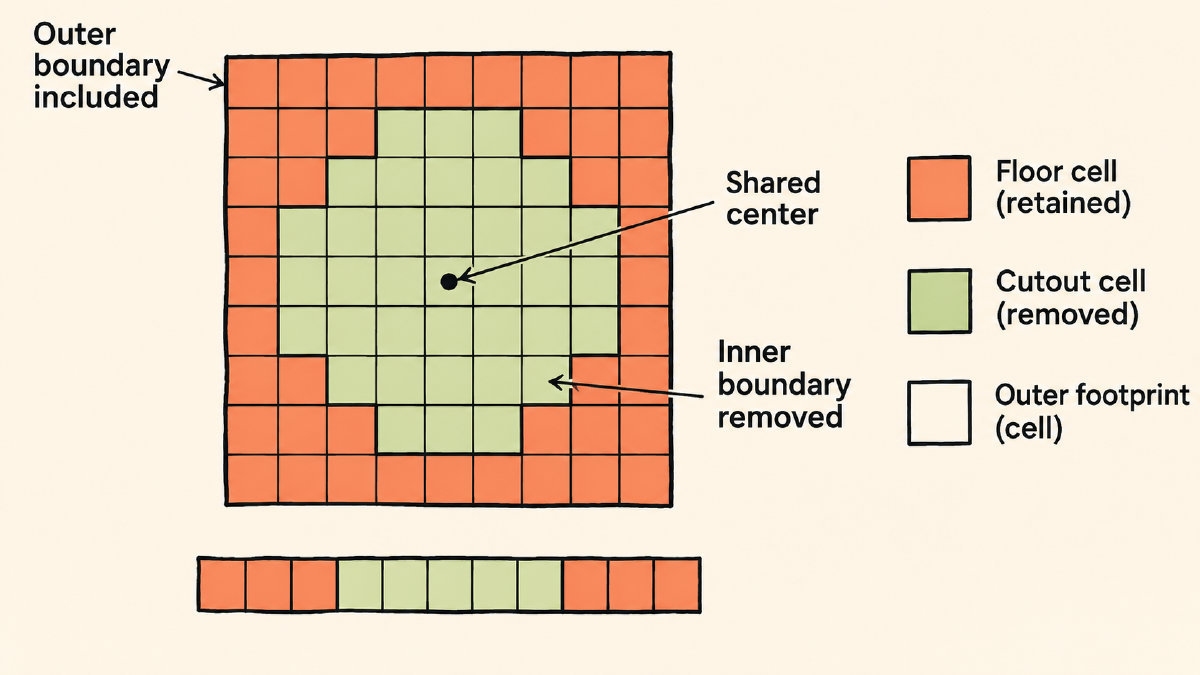
That leaves us with two concentric outlines that we can use to determine which blocks are included in the final count. The image below shows how to proceed.
Using the default convention (that the outer boundary belongs to the floor and the inner boundary belongs to the hole), you can see how each aligned row contributes to the overall count of blocks.
Each aligned row consists of the outer-footprint cells minus the inner-cutout cells. Summing the row differences gives you the exact count for the selected footprints.
As an alternative, we can retain the inner outline as a part of the floor. What’s important is that we only remove the cells strictly inside the inner outline. Retaining the inner outline as a part of the floor changes which cells are removed.