How to Measure Diameter of a Minecraft Circle
Learn how to measure diameter of a Minecraft circle by counting its full block span, including both ends, and finding odd or even centers.
On this page
Minecraft circles are often placed at the center of an island or in some other location, where their diameter is needed for something else. The diameter of a circle is defined as being straight through its center and connecting two opposite points. So how does one measure it?
In general, this depends on the circle’s placement. For example, you can’t just measure along the circle’s circumference (because that’s not straight), but rather must measure across the circle’s diameter.
But in a game world that uses a grid system, such as Minecraft, measuring the distance across the center is easier than it seems. A simple rule: count the number of blocks between the outside edges of the circle, inclusive, to find the circle’s diameter.
This article will discuss how to use block coordinates to determine the diameter of any circle in your Minecraft world. I’ll show how even and odd-sized circles differ, what determines the center point of the circle, and when to subtract 2 from the span.
Symmetrical Circles
A circle in Minecraft is symmetrical. Therefore, you can place your compass on the center of the circle, and a full 360-degree turn will trace the boundary of the circle. But if you want to know the width of the circle, you need to know the diameter, which goes from one side of the circle through its center to the other side.
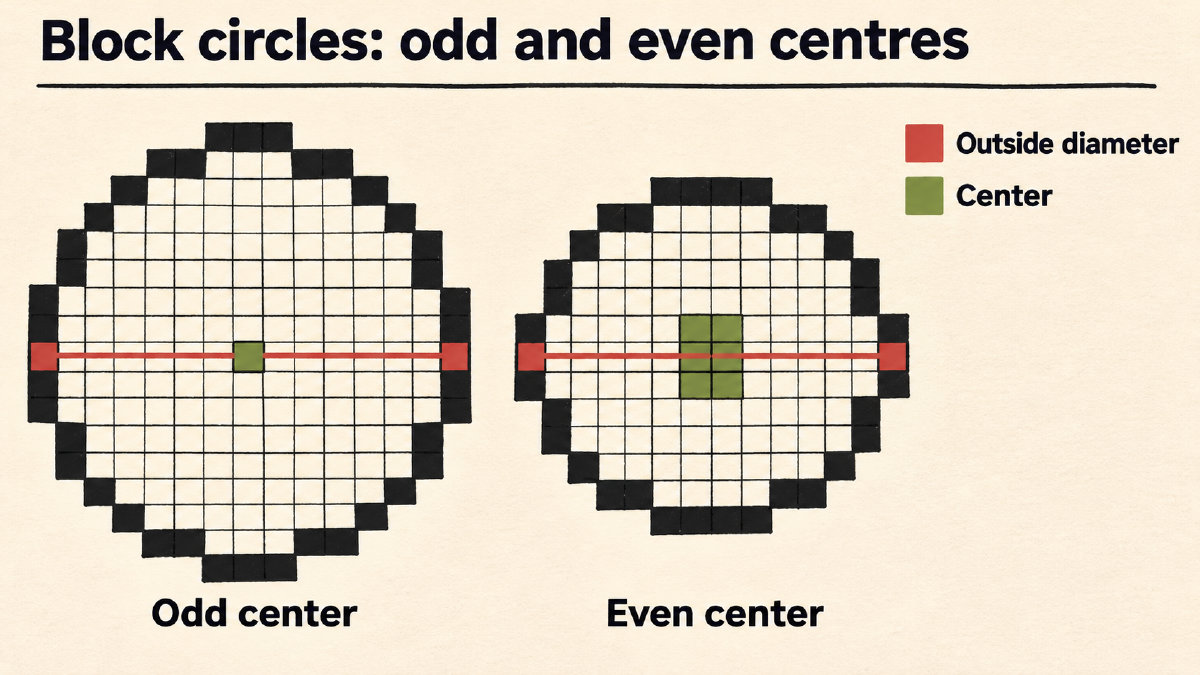
The easiest way to do this is to measure from the leftmost boundary block of the circle to the rightmost boundary block of the circle. Measure along X or Z through the center, counting every block position even where the interior is empty. For a symmetrical horizontal circle, both axes should give the same outside width.
Let’s say you have a circle with a 100-block radius; then the diameter would be 200 blocks wide. If the circle were drawn with a 10-block radius, then the diameter would be 20 blocks wide. In general, a circle spans twice the radius.
So, using coordinates to determine the diameter of a circle requires knowing the starting and ending position. Because Minecraft measures coordinates in units of one block, the difference in coordinate units will equal the number of blocks between them. But because the endpoints of the circle’s diameter must both include the block boundaries, we have to adjust accordingly.
The formula for calculating the diameter of a circle in Minecraft is:
Outside Width = larger endpoint coordinate − smaller endpoint coordinate + 1
For example, consider a circle that spans from 100 to 110 in the X dimension. The larger coordinate is 110, the smaller is 100. Then the total span is 110 − 100 + 1 = 11 blocks.
Similarly, consider a circle that spans from −5 to +5 in the Z dimension. That’s a span of 5 − (−5) + 1 = 11 blocks.
Block Position vs. Player Coordinate
Your player coordinates are measured relative to the world origin. Your player coordinate is the center at the bottom of your player’s collision box. When you move into the next block, your coordinate changes again.
Therefore, it makes sense to define a block’s position as its lower-left corner. You could imagine each block as having its own coordinate system.
So when measuring the width of a circle, remember that Minecraft uses integer coordinates inside of the blocks themselves. Block positions are integers; player coordinates can contain decimals.
In Minecraft, a player’s position is recorded as floating-point numbers. For example, your position might be (4693542, 72, 5761245). The first and third coordinates correspond to the x- and z-axes, while the second corresponds to the y-axis. All world coordinates are relative to the fixed world origin, where X, Y, and Z are zero, rather than to the spawn point.
Each coordinate has three dimensions (x, y, and z), each corresponding to the direction in the respective axis. To determine how many blocks exist between two points, subtract the lower number from the higher number and add 1. Remember that both endpoints must be included. Let’s look at a few examples:
Example 1: Coordinates from 100 to 110. Larger coordinate is 110, smaller is 100. 110 − 100 = 10. Add 1 gives you 11 blocks.
Example 2: Coordinates from -5 to +5. Larger coordinate is 5, smaller is -5. 5 − (-5) = 10. Add 1 gives you 11 blocks.
Example 3: Coordinates from 400 to 500. Larger coordinate is 500, smaller is 400. 500 − 400 = 100. Add 1 gives you 101 blocks.
Odd and Even Spans
You can see that whether a circle has an even or odd number of positions is dependent upon how the circle is drawn. For example, if a circle spans from 0 to 100, there are 101 positions, an odd number. If it spans from 1 to 101, there are also 101 positions.
However, if a circle spans from 0 to 101, there are 102 positions, an even number. Likewise, if it spans from 1 to 102, there are 102 positions.
Why? Because of the way Minecraft calculates the positions of the blocks.
Now, if a circle spans 11 positions, five positions exist to either side of the middle position. If a circle spans 102 positions, 51 positions exist on either side of the middle between the two central positions.
The circle is considered to be symmetric across the horizontal plane. Thus, the center of the circle is located in the center of the middle block or the junction of four blocks, depending on whether the number of positions is odd or even.
Measuring the Clear Opening
It’s important to differentiate between the outside diameter of the circle and the clear opening of the circle.
When a circle is drawn, it’s possible that there are no gaps between the blocks used to create it. But it’s also possible that the borders of the circle are quite thick, creating a relatively small opening inside the circle. Or the circle might be entirely hollow.
So, how do you measure the clear inside opening? Well, the circle may be surrounded by empty blocks, and the interior may be open. The circle may be entirely hollow, leaving nothing behind except for the circular hole itself.
Either way, the method of measuring the circle’s clear inside opening is similar. First, locate the exact position of the center of the circle. Then, check to see whether the span through the center has exactly one boundary block at each end and only empty space between them.
If so, subtract two blocks from the outside diameter to find the clear inside opening.
Otherwise, simply measure the opening directly.